
How to Choose the Right Rock Painting Kit for Wholesale Buyers?
Sourcing rock painting kits feels overwhelming with so many options. Choosing the wrong one hurts your profits and brand reputation1. Focus on asking your supplier the right questions.
The "right" rock painting kit is one that perfectly matches your target market's needs and fully complies with your region's safety standards. It involves balancing component quality, packaging appeal, and your desired retail price point, not just counting the pieces inside the box.

As a supplier, I talk to wholesale buyers every day. A frequent question we receive is, "What's your best rock painting kit?" The simple answer is that there isn't one. The "best" kit for a high-end toy boutique in the US is completely different from the "best" kit for a discount chain in Europe. The real challenge, and the key to success, is learning how to define what "best" means for your specific business goals.
Choosing a kit isn't just about picking a product off a list; it's a risk management exercise. You need to ensure the product delights the end customer, builds your brand, and won't cause any compliance headaches. Let’s break down the critical factors that experienced buyers focus on to make a profitable and safe choice.
How Do You Define 'Quality' Beyond the Component Checklist?
You're comparing kits with the same number of rocks and paints. But you know user reviews will tank if the paint is bad or the brushes are flimsy. Let's redefine quality.
True quality isn't just a count of items. It's found in the non-toxic, vibrant paint, durable brushes that don't shed, smooth rocks ready for painting, and clear instructions. These details directly impact customer satisfaction and your brand's reputation.2
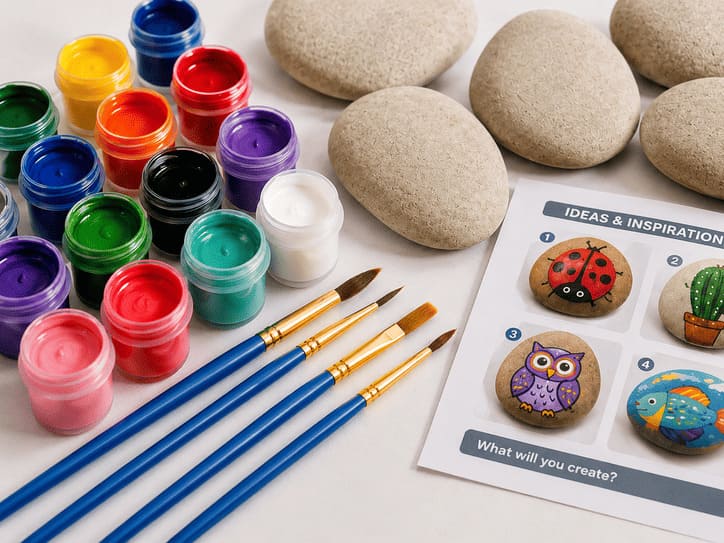
First-time importers often get stuck comparing component lists. They'll ask if our kit has 10 rocks or 12, or 8 paint colors versus 10. While quantity matters, experienced buyers have learned to look past the numbers and ask about the quality of those components. A kit with 8 high-quality, vibrant paint pots will create a much better user experience than a kit with 12 watery, transparent colors. The end customer, a child, won't count the rocks; they will remember if the paint was fun to use and if their creation looked bright and beautiful. This is what leads to positive reviews and repeat business.
When we discuss quality, we break it down into factors that affect the user experience.
Key Quality Indicators for User Experience
| Component | What to Look For | Why It Matters for Your Business |
|---|---|---|
| Paint | Good coverage, vibrant color, non-toxic certification. | Poor paint leads to bad reviews and safety concerns. Good paint creates beautiful results and happy customers. |
| Brushes | Bristles that don't fall out, easy-to-hold handles. | Flimsy brushes are frustrating to use and make the entire kit feel cheap, damaging your brand's perceived value3. |
| Rocks | Smooth, flat surfaces, good size variety. | Porous or rough rocks absorb too much paint and are difficult to draw on, leading to a frustrating experience for the child. |
| Instructions | Clear, simple language with pictures or design ideas. | Confusing instructions can prevent a child from even starting the activity, resulting in returns and negative feedback. |
Why is Customization More Important Than the Off-the-Shelf Price?
An off-the-shelf kit seems cheap and easy. But it won't stand out on the shelf, connect with your customers, or build your brand's unique identity.
Customization allows you to build a unique product that reflects your brand and meets your market's specific demands. Through OEM/ODM and private labeling, you control the packaging, design, and components, creating a product that stands out and justifies a better price.
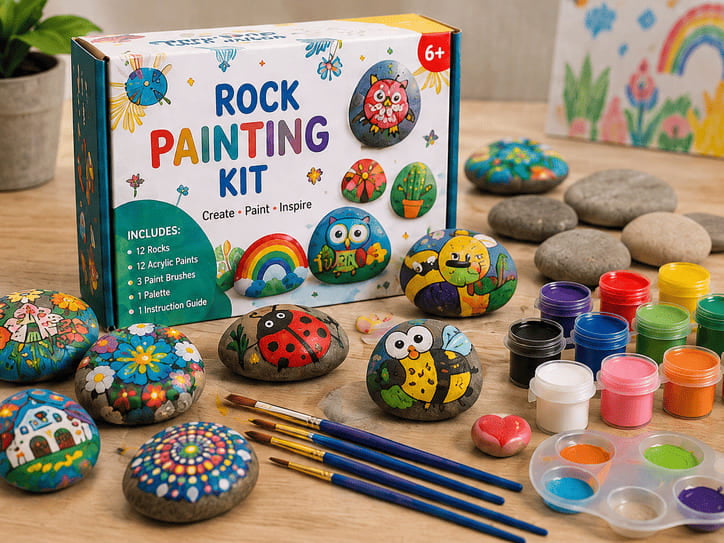
Many new buyers focus heavily on the unit price of a standard, generic kit. But the lowest price often comes at a cost to your brand. A generic box with a simple sticker won't capture a customer's attention in a crowded retail environment4. This is where customization becomes your most powerful tool. As your manufacturing partner, we can help you with services like OEM, ODM, and private labeling to create a product that is uniquely yours. This allows you to command a better retail price and build long-term brand equity5. Instead of just selling a toy, you're selling your brand's experience.
Let's clarify what these customization options mean for you.
Unlocking Brand Value with Customization
- Private Label: This is the simplest step. We take one of our existing, proven rock painting kits and produce it with your logo and branding on the packaging. It's a fast way to get your brand onto a quality product.
- OEM (Original Equipment Manufacturer)6: You provide us with a complete design for the product and packaging, and we manufacture it to your exact specifications. You have full control over the final product's look, feel, and components.
- ODM (Original Design Manufacturer)7: You come to us with an idea or concept, and our team helps you develop it into a finished product. We collaborate on the design, components, and packaging to bring your vision to life.
This moves the conversation from "How much does it cost?" to "How can we create the best product for my customers?"
How Do You Ensure Your Kits Are Safe and Compliant for Your Market?
You've found a great-looking, low-cost kit. But a single compliance failure could get your entire shipment seized by customs or lead to a product recall8, destroying your profits.
To ensure compliance, you must verify that all materials, especially the paints, meet the specific toy safety standards for your target market. For example, you must request test reports for ASTM F9639 (USA) or EN-7110 (Europe). A reliable supplier provides this documentation proactively.
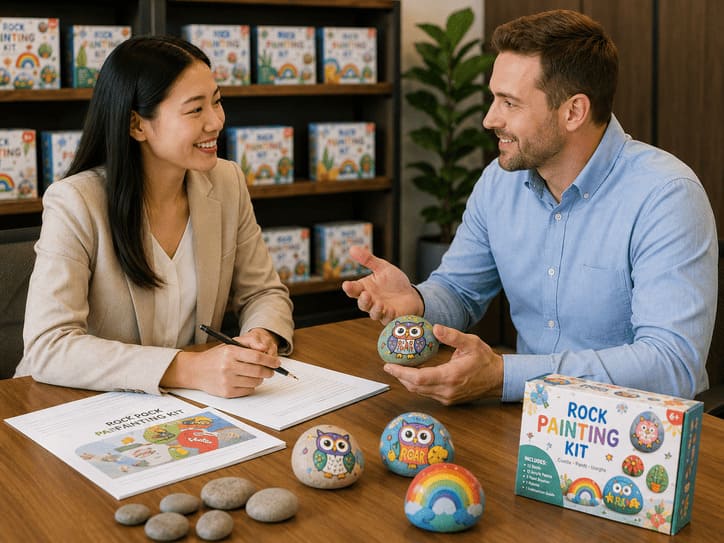
Product safety is not negotiable. For children's products, especially those with paints and small parts like a rock painting kit, compliance with safety standards is the most important part of your sourcing process. A failure here represents a massive business risk. I've seen importers get entire shipments stopped at the border because they didn't have the right paperwork. The responsibility for compliance falls on you, the importer.11 Therefore, you must work with a supplier who understands these requirements and can provide the necessary documentation.
A common question we get is, "Is your product safe?" An experienced buyer asks a more specific question: "Can you provide the EN-71 test reports for the paint you use?" This shows they understand the risk. We expect these questions and have the documentation ready. It’s a critical checkpoint in establishing a professional partnership.
Major Toy Safety Standards by Market
| Market | Key Standard | What It Primarily Covers |
|---|---|---|
| USA | ASTM F963 | Safety of materials (e.g., lead and heavy metals in paint), small parts hazards, mechanical safety. |
| Europe | EN-71 | Similar to ASTM, covers chemical properties (toxicity), flammability, physical and mechanical properties. |
| Australia/NZ | AS/NZS ISO 812412 | Largely harmonized with EN-71 and ASTM standards, covering mechanical and chemical safety. |
Always confirm the specific requirements for your country and ask your supplier for up-to-date test reports for the exact components in your kit.
What Questions Should You Ask a Supplier to Find a True Partner?
You send out dozens of price inquiries to different suppliers. Most replies are just a price list, leaving you to figure everything out on your own. This is not a path to success.
Instead of just asking for a price, ask about their experience with your target market, their customization capabilities (OEM/ODM), and their process for ensuring quality and compliance. A true partner will ask you questions in return about your goals and customers.
The goal of your initial outreach should not be to get a price, but to find out if a supplier is a good fit for your business long-term. You are looking for a partner, not just a transactional trader who moves boxes. A partner is invested in your success because it leads to their success. They use their experience to guide you, help you avoid common mistakes, and build the best possible product for your market. The easiest way to tell the difference is by the questions you ask, and the questions they ask you in return.
When a potential client contacts us at Shinegifts, our first step isn't to send a generic catalog. We ask about their business. Who is their end customer? What retail channels do they sell through? What is their brand identity? The answers to these questions help us recommend a solution, not just a product. This dialogue is the foundation of a healthy, long-term business relationship and a key sign you've found a supplier who can do more than just give you a price.
Questions to Identify a Partner Supplier
- "What is your experience exporting to [Your Country/Region]?"
- "Can you walk me through your quality control process for this product?"
- "What customization options (OEM/ODM) are available for this kit?"
- "Can you provide current EN-71 / ASTM F963 test reports for the paints?"
- "What are some common challenges or successes you've seen with this product in my market?"
Conclusion
Choosing the right rock painting kit is a strategic decision, not a simple purchase. It requires you to find a supply partner who helps you match the product to your market perfectly.
"The impact of brand image on customer satisfaction and brand loyalty", https://pmc.ncbi.nlm.nih.gov/articles/PMC11378958/. Research in supply chain management and marketing indicates that sourcing products of poor quality can lead to increased costs from returns and recalls, as well as long-term damage to brand equity and customer trust. Evidence role: general_support; source type: education. Supports: The claim that poor product quality and sourcing decisions can lead to significant financial losses and harm a company's brand image.. ↩
"Effects of Design Aesthetics on the Perceived Value of a Product", https://pmc.ncbi.nlm.nih.gov/articles/PMC8359925/. Studies in consumer behavior consistently show a strong correlation between perceived product quality, including the performance of individual components, and overall customer satisfaction, which in turn influences brand loyalty and online reviews. Evidence role: general_support; source type: paper. Supports: The claim that tangible product characteristics are a primary driver of customer satisfaction and subsequent brand perception.. ↩
"The impact of perceived value on brand image and loyalty - PMC", https://pmc.ncbi.nlm.nih.gov/articles/PMC11484097/. Marketing research demonstrates that consumers often use the tangible quality of product components as a heuristic to judge the overall quality and value of a brand, with poor components leading to a negative perception. Evidence role: mechanism; source type: paper. Supports: The claim that the quality of a product's individual components serves as a key signal to consumers, directly influencing their perception of the brand's overall value and quality.. ↩
"The influence of creative packaging design on customer motivation ...", https://www.sciencedirect.com/science/article/pii/S0148296322003630. Studies on in-store consumer behavior show that packaging design is a critical factor in attracting visual attention, with a significant percentage of purchasing decisions being made at the shelf, influenced by a product's visual appeal. Evidence role: statistic; source type: paper. Supports: The claim that unique and appealing packaging is critical for attracting consumer attention at the point of sale.. ↩
"Customer Preferences in Retail: Private Labels and Brand ...", https://spiegel.medill.northwestern.edu/customer-preferences-in-retail-private-labels-and-brand-loyalty/. Business and marketing principles support the strategy that product differentiation through private labeling or customization can reduce direct price competition, allowing brands to command premium pricing and build distinct brand equity over time. Evidence role: general_support; source type: education. Supports: The claim that creating a unique product through customization or private labeling can lead to greater pricing power and increased brand equity.. ↩
"Original equipment manufacturer - Wikipedia", https://en.wikipedia.org/wiki/Original_equipment_manufacturer. An Original Equipment Manufacturer (OEM) is a company that produces parts and equipment that may be marketed by another manufacturer. The provided definition aligns with this model, where the buyer provides the design specifications for production. Evidence role: definition; source type: encyclopedia. Supports: The definition of Original Equipment Manufacturer (OEM) as a process where a company manufactures products or components that are then marketed by another company under its own brand name.. ↩
"Original design manufacturer - Wikipedia", https://en.wikipedia.org/wiki/Original_design_manufacturer. An Original Design Manufacturer (ODM) is a company that designs and manufactures a product, as specified, which is then rebranded by another company for sale. This process often involves the manufacturer contributing to the product's design and development based on the buyer's concept. Evidence role: definition; source type: encyclopedia. Supports: The definition of Original Design Manufacturer (ODM) as a company that designs and manufactures a product, as specified, that is eventually rebranded by another firm for sale.. ↩
"CBP Seizes Toys with CPSC Violations", https://www.cbp.gov/newsroom/local-media-release/cbp-seizes-toys-cpsc-violations. Government bodies such as the U.S. Consumer Product Safety Commission (CPSC) and the European Commission's Safety Gate regularly report on imported products, including toys, that are stopped at the border or recalled from the market for failing to meet mandatory safety standards. Evidence role: case_reference; source type: government. Supports: The claim that non-compliant products, especially toys, are subject to seizure at the border and can be subject to forced recalls.. ↩
"ASTM F963 Requirements | CPSC.gov", https://www.cpsc.gov/Business--Manufacturing/Business-Education/Toy-Safety/ASTM-F-963-Chart. The U.S. Consumer Product Safety Commission (CPSC) mandates that toys sold in the United States must comply with the ASTM F963 standard, which addresses numerous hazards, including chemical properties like heavy metal content, as well as mechanical and physical properties like small parts and sharp edges. Evidence role: definition; source type: government. Supports: The description of what the ASTM F963 toy safety standard covers.. ↩
"EN 71 - Wikipedia", https://en.wikipedia.org/wiki/EN_71. The EN-71 series of standards is the legal benchmark for toy safety in the European Union under the Toy Safety Directive. It is composed of multiple parts covering requirements and test methods for mechanical and physical properties, flammability, and the migration of certain chemical elements. Evidence role: definition; source type: government. Supports: The description of the scope of the EN-71 toy safety standard.. ↩
"Duty to Report to CPSC: Rights and Responsibilities of Businesses", https://www.cpsc.gov/Business--Manufacturing/Recall-Guidance/Duty-to-Report-to-the-CPSC-Your-Rights-and-Responsibilities. According to guidance from regulatory bodies like the U.S. Consumer Product Safety Commission (CPSC), the importer is considered the domestic manufacturer and is legally responsible for ensuring that imported products meet all applicable U.S. safety standards. Evidence role: general_support; source type: government. Supports: The claim that the legal responsibility for ensuring a product complies with local safety regulations rests with the importer.. Scope note: This legal responsibility is specific to the jurisdiction; for example, EU regulations place similar obligations on importers into the European Union. ↩
"Noise Producing Toys and the Efficacy of Product Standard Criteria ...", https://pmc.ncbi.nlm.nih.gov/articles/PMC3924436/. The AS/NZS ISO 8124 series is the mandatory safety standard for toys in Australia and New Zealand. It is largely based on the international ISO 8124 standard, which itself is harmonized with key aspects of Europe's EN-71 and the USA's ASTM F963 standards, covering mechanical, flammability, and chemical hazards. Evidence role: definition; source type: government. Supports: The description of the AS/NZS ISO 8124 standard and its harmonization with other international standards.. ↩


Leave a Comment